Accessible Budapest should be planned from the actual room, route and entrance rather than a general promise that the city is barrier-free. Current BKK information identifies M3 and M4 as accessible throughout, while M2 still has only selected accessible stations. That is a significant correction to older guides, but it does not remove the need to check lifts, surface routes and individual venue facilities. [1]
Confirm the accommodation in practical detail
Begin with the features that determine whether the room works for you: step-free entry, lift dimensions, clear door width, bed height, transfer space and bathroom layout. A hotel can describe itself as accessible while offering a room that does not match your particular equipment or transfer needs.
Request photographs and measurements for the exact room category. Ask whether the shower is truly level, whether the chair or bench supplied is suitable and whether the toilet has usable space on the side you need. General marketing photographs of a lobby do not answer those questions.
Get the essential features confirmed in writing and establish that the suitable room is reserved rather than merely requested. Discuss an alternative in advance if the room becomes unavailable. This is especially important for a restrictive booking made through an intermediary.
Choose location by usable connections. A property close to a famous attraction may still involve steep or awkward approaches, while a slightly more distant hotel on a reliable accessible route can make the whole visit easier.
Arrange airport assistance and the onward vehicle separately
Budapest Airport's assistance form encourages advance notice, preferably well ahead of travel and at least forty-eight hours before departure for the relevant arrangements. Notify the airline or booking agent as well, and describe the help required rather than using a vague label. [3][4]
Walking long terminal distances, negotiating aircraft steps and transferring to the seat are different needs. Traveling with your own wheelchair also requires equipment information such as dimensions, weight and battery details to be agreed with the airline.
Keep handling instructions and photographs available, especially for removable or delicate components. Assistance at the terminal does not automatically mean every staff member already knows how your personal equipment should be moved.
The hotel transfer is a separate booking. Confirm whether you remain seated in the chair, the vehicle's usable dimensions and the restraint arrangement. A large car or minivan is not automatically wheelchair-accessible. Agree on the precise meeting point and what happens if the flight arrives late.
Use the updated metro picture, not an old blanket warning
BKK's current Hungarian accessibility page states that all stations on M3 and M4 are accessible, with arrangements including inclined lifts where relevant. Older descriptions that treat M3 as generally inaccessible no longer provide an accurate basis for planning. [1]
M2 is different. The current information identifies accessible provision at selected stations, including Örs vezér tere, Pillangó utca and Puskás Ferenc Stadion. BKV's discussion of broader M2 accessibility is a development plan, not evidence that every station has already been converted. [1][2]
This distinction matters when choosing a hotel or transfer. A journey that works on M3 may fail if the final destination requires an inaccessible M2 exit. Evaluate each station and interchange rather than treating all metro lines as equivalent.
Check operational information before leaving, because an accessible design still depends on working lifts. Save an alternative surface route or accessible vehicle contact when a particular lift is critical to the day's plan.
Buses can help, but the full boarding route still matters
BKK's current information describes low-floor buses across its bus operation. That provides useful options, but the vehicle is only one part of the journey. The stop approach, curb, ramp and space inside still need to work for the traveler. [1]
Use BudapestGO to plan the actual route and identify the relevant stop. Signal your need for ramp assistance clearly and allow time to board without rushing. A plan depending on a last-second transfer creates avoidable pressure. [9]
Trams and other services have their own vehicle and stop arrangements. Do not assume that the accessibility of one modern line extends to every tram route in the city. Check the specific departure and connection.
Concessions are a separate issue from physical access. A foreign disability document does not automatically establish every local fare entitlement. Confirm the applicable rules and buy the required ticket when eligibility is not clear, rather than relying on a general statement that disabled travelers ride free.
Choose museums with detailed entrance information
The Museum of Fine Arts publishes specific access arrangements involving an external lift and internal routes, with staff assistance needed for certain areas such as a stairlift connection. This is more useful than a simple wheelchair symbol because it identifies where help may be required. [5]
Ask about the exact exhibition you want to see. A temporary display can occupy a different area from the permanent collection, and the usable route should connect the entrance, galleries and toilet rather than solve only the first step into the building.
The museum's ticket page also sets conditions for concessions and supporting documentation, including language requirements in relevant cases. Read those conditions instead of assuming that every card issued abroad is automatically accepted in the same way. [6]
Ludwig Museum describes access across its floors and the possibility of arranging a loan wheelchair, with documentation and companion conditions explained separately. A limited supply of loan equipment should be reserved when it is essential to your visit. [7]
A bath visit needs its own access decision
Thermal bathing is often recommended as a universal Budapest activity, but pools, changing areas, wet surfaces and transfer arrangements require a more specific assessment. Ask the chosen operator about the route and assistance needed for the actual facility you intend to use.
Do not rely on Gellért Bath as an operating option. Its official information states that it closed on October 1, 2025 for renovation, with reopening planned for 2028. A planned future reopening is not current availability. [8]
For another bath, confirm accessible changing, toilets, pool entry and whether a companion can remain with you where needed. A ramp into the building does not establish independent access to the water.
Choose the visit only when the answers make it workable and enjoyable. There is no need to include a bath merely because it appears on every city list; another cultural or riverside activity may better suit the traveler.
Keep the city route modest and the essential facilities certain
Plan toilets and rest stops before a long outdoor segment. Confirm whether a facility is inside a paid attraction, requires a key or closes with a café. A restaurant reservation should include entrance and restroom questions when those determine whether the meal is possible.
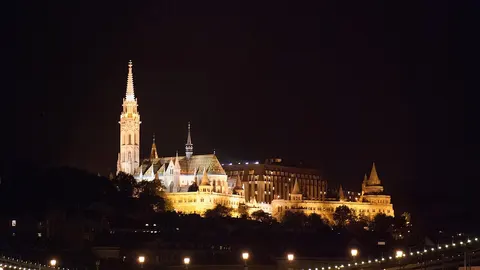
For Castle Hill or another elevated area, use transport to reduce unnecessary climbing where suitable, but remember that descending can also be difficult. The shortest pedestrian route is not always the safest or most comfortable one.
Weather and crowding can change the effort involved. Leave room to shorten a walk without losing the day's main activity, and keep essential confirmations offline in one place: hotel, transfer, entrances and contact numbers.
Accessible Budapest is strongest when current infrastructure information is combined with personal requirements. Updated M3 access expands the options, but the successful trip still depends on the exact chain from room to vehicle to venue. Confirm those links and keep the optional parts flexible so that the traveler, not the itinerary, controls the pace.