
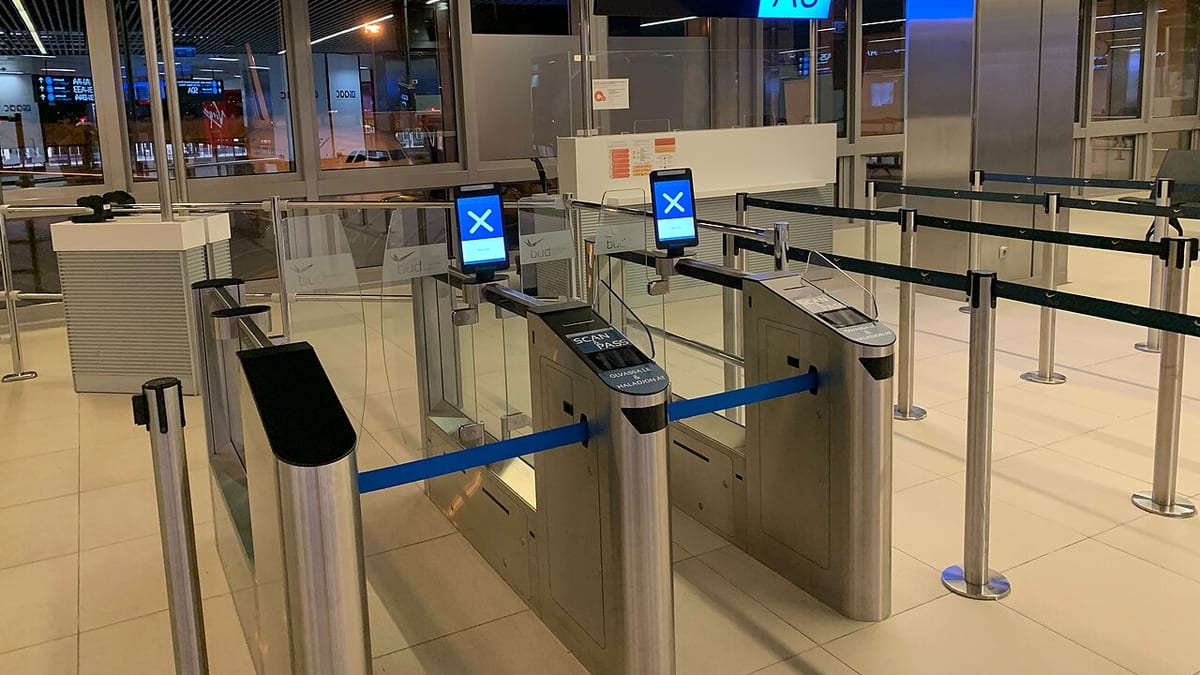
Budapest Airport passport control matters when your journey crosses the Schengen external border, not simply because the flight is international. For covered non-EU short-stay travelers, EES adds digital registration and biometric checks. Keep arrival plans flexible, carry any residence documents with your passport and budget separately for border control, baggage and the next stage of your journey. [1] [2]
Follow the journey, not an airport shortcut
A flight from another Schengen airport normally reaches Budapest without a routine external-border entry check. A flight from a non-Schengen destination brings you to that border when entering Hungary. On departure, the equivalent distinction determines whether an exit check is part of the route to the gate. Budapest Airport publishes passport-control information separately from its security-screening guidance. [1]
That separation is important. Security asks whether you and your belongings can safely enter the departure area. Border control establishes whether you may enter or leave the relevant territory on your documents. A boarding-pass scan is a third task. Completing one does not mean you have completed the others.
For example, arriving from London and visiting Budapest involves entering Schengen in Hungary. Arriving from Vienna normally does not involve a new external-border entry, because the flight remains within Schengen. These examples explain the geography of the process; the individual passenger's nationality and residence status still determine document requirements and eligibility for particular lanes.
When connecting, write down both flight sectors and whether you must collect a bag. Avoid using a terminal label as the entire answer to an immigration question. Ask the airline about the actual airside route and through-baggage arrangements, especially when the flights are on separate reservations. A connection shown by a booking website is not enough to establish that all immigration and transfer requirements have been handled for you.
Understand what EES asks you to do
EES records covered travelers' entries and exits electronically, using travel-document information and biometric data. At a first registration, the process can include a facial image and fingerprints; subsequent crossings involve checks against the existing record. Follow the directions at the airport rather than assuming a previous registration removes every later step. [2]
Budapest Airport has published local information about introducing the system and directs passengers to its passport-control guidance. The European Commission confirms that EES became fully operational across the participating Schengen countries on 10 April 2026. Older references to a future rollout should therefore not be used to plan an October 2026 or later journey. [3] [4]
Do not purchase an unofficial "EES registration" merely because a search advertisement suggests you need one before flying. EES is a border process, and the UK government's Hungary guidance states that registration is free. Travelers using that advice should note its British-citizen scope and consult the relevant authority for other document circumstances. [5]
Children under twelve are not fingerprinted, but can still need a facial image and the appropriate border process. Families should have each child's document ready and seek help with equipment that is unsuitable for a small child. A fingerprint exemption is not permission to bypass immigration. [5]
Residence status can change the correct procedure
Some travelers are exempt from EES registration because of qualifying residence or long-stay status. The EU's official guidance sets out those categories. Carry the actual supporting document with your passport and present it when relevant; the border officer cannot reliably infer your status from an airline ticket or a hotel booking. [6]
This deserves attention from people who normally think of Hungary as home. A valid residence card may be more important to the correct border treatment than the fact that the passport itself is non-EU. Keep the documents together rather than storing one in a checked bag and assuming it will not be needed.
For mixed-nationality couples or families, ask staff how to proceed together. Do not split the group between different lanes without agreeing where to meet and confirming the arrangement for children or anyone needing assistance. The shortest visible queue is not necessarily the correct one for every person.
Ordinary non-EU short-stay visitors should also confirm passport validity, visa requirements and permitted length of stay before departure. The EU's travel-document guidance includes the standard issue-date and remaining-validity conditions and notes that officials may request supporting evidence. Residence rights and other exceptions require their own assessment rather than a one-size-fits-all checklist. [7]
Security waiting times do not measure immigration
Budapest Airport displays waiting information for security on the Terminal 2A and 2B sides. Those figures can help with a departure, but they do not describe passport-control queues. A reassuring security display therefore does not establish that a non-Schengen passenger has no further delay before reaching the gate. [8]
The same distinction applies to Fast Track. The airport sells it as a dedicated security lane, not as a product that guarantees faster border processing. Buy it for the service it actually provides, rather than as insurance against every possible airport queue. [9]
On arrival, the sequence also includes leaving the aircraft and, when relevant, baggage reclaim after border formalities. A scheduled landing time is not a guaranteed time at the taxi rank. For a driver pickup, understand when the included waiting period starts and how to contact the operator if immigration takes longer than expected.
For a rail connection from the city, allow for the airport-to-station journey as a separate component. A flexible ticket may be a better choice than a cheap departure that depends on an unusually smooth arrival. This is a planning recommendation, not a measured prediction of how long Budapest immigration will take.
Give connections and disruptions a realistic margin
Separate-ticket self-transfers deserve particular caution. You may need to collect luggage, meet the next airline's check-in deadline and complete a new departure process. Even hand-baggage-only travel does not prove that every airline combination allows the airside connection you imagined. Confirm the procedure before relying on a short interval.
When disruption occurs, speak to the operating airline about the flight and onward arrangements. Budapest Airport's passenger-care information distinguishes the airport's support role from airlines' responsibilities during delays and cancellations. Keep booking references and airline contact details available offline so you can explain the exact itinerary. [10]
For departures beginning in Budapest, the airport's summer 2026 advice recommends arriving at least two and a half hours before the flight. Follow any more specific airline instructions and allow for additional document or assistance needs. Do not subtract time from that plan just because you have checked in online or bought priority security. [11]
Finally, EES and ETIAS should not be confused. At the date of research, the EU's ETIAS application information still states that applications are not being collected. The status should be checked again for a later trip, but an announcement about ETIAS is not a reason to misunderstand the border registration already operating at Budapest. [12]
Sources
- Budapest Airport: passport controlwww.bud.hu
- European Union: how EES registration workstravel-europe.europa.eu
- Budapest Airport: introduction of EES at the airportwww.bud.hu
- European Commission: EES and ETIAS differences, 28 April 2026home-affairs.ec.europa.eu
- UK Foreign Office: Hungary entry advice for British citizenswww.gov.uk
- European Union: Entry/Exit System questions and exemptionstravel-europe.europa.eu
- European Union: travel documents for non-EU nationalseuropa.eu
- Budapest Airport: security-screening information and queue displayswww.bud.hu
- Budapest Airport: Fast Track Lane, price and family eligibilitywww.bud.hu
- Budapest Airport: passenger care and disruption responsibilitieswww.bud.hu
- Budapest Airport: summer 2026 travel guidancewww.bud.hu
- European Union: ETIAS application statustravel-europe.europa.eu