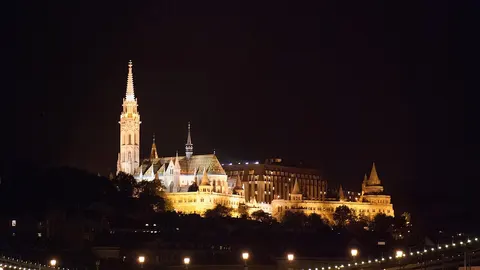
Budapest's Advent Basilica and Vörösmarty Square markets open on 13 November 2026, while Óbuda's programme begins on 27 November. Choose by date and setting, then check holiday hours separately. The key late-season detail is that Vörösmarty's craft stalls and children's railway finish before its final New Year period, so a market that remains partly open may not offer the same experience as in early December. [1][2][3]
Start with three different calendars
The principal markets do not share one universal Budapest Christmas season. Their operators publish separate dates, hours and activity calendars, which should guide the itinerary before you choose where to eat or shop.
| Market | Published 2026–27 season | Important distinction |
|---|---|---|
| Advent Basilica | 13 November–1 January | A central option continuing into New Year's Day |
| Vörösmarty Classic Xmas | 13 November–31 December, with the final night extending into 1 January | Craft stalls and the children's railway end earlier, on 28 December |
| Advent in Óbuda | 27 November–23 December | A separate neighborhood programme with its own events |
These are the operators' published season dates. A season window does not mean every stall or activity runs continuously, and special holiday hours can shorten an otherwise familiar evening visit. [1][2][3]
For a mid-November trip, the two central markets provide the relevant options. For a visit after 23 December, Óbuda should not remain on the itinerary merely because it appears in a general Christmas-market list.
Advent Basilica: read the holiday hours
Advent Basilica's published normal hours are 11:00–22:00 from Sunday to Thursday and until 23:00 on Friday and Saturday. On 24 December, the market closes at 15:00; the listed closing time for 25 and 26 December is 20:00. Those exceptions matter more than the ordinary weekly pattern when visiting over Christmas. [1]
The setting by the basilica makes it easy to combine the market with other central activities, but the church and any separately ticketed visitor experiences retain their own admission arrangements. A market visit should not be described as including every nearby interior or viewpoint.
Choose the purpose of the stop. A visitor interested in the evening atmosphere may plan around darkness, while someone focused on shopping may prefer another part of the day. Neither choice guarantees a particular crowd level; it simply aligns the visit with what you want to do.
Use the current programme for any scheduled display or performance. A recurring event name does not establish that a previous year's presentation times remain unchanged. The operator's programme is the source for the actual day rather than an old photograph or a copied timetable. [4]
Vörösmarty: the late-season offer changes
Vörösmarty Classic Xmas publishes normal opening from 11:00–21:00 Sunday to Thursday and until 22:00 on Friday and Saturday. Its Christmas Eve window is 10:00–14:00, with 12:00–18:00 listed for 25 and 26 December. The Hungarian timetable is useful for reading the holiday exceptions clearly. [2][5]
The most consequential detail is the 28 December end of the craft stalls and children's railway. A later visit can therefore differ from an earlier December outing even while parts of the market continue toward New Year. Do not promise the full shopping and family-activity experience from the overall closing date alone. [5]
For a shopper, this may be a reason to visit before the final few days. For someone primarily interested in food and the central atmosphere, a later opening can still be relevant. The recommendation depends on the activity, not just whether the market is technically listed as open.
A family should identify the exact attraction it wants and check its operating calendar. A children's activity displayed in promotional images is not automatically available throughout the whole market season, and a public market visit does not necessarily include every paid experience.
Óbuda is a separate outing, not an overflow square
Advent in Óbuda runs from 27 November to 23 December 2026, with Fő tér as a principal location and a programme that includes other local venues. It is best approached as its own neighborhood visit rather than as a central-market stop that happens to be slightly farther away. [3][6]
Choose a particular event or a manageable visit window, then arrange the journey around it. A broad advent programme can contain activities on selected days, so the season's opening and closing dates do not establish that every performance or workshop is available whenever you arrive.
The change of setting can be worthwhile for visitors spending several days in Budapest. It adds variety to a trip that would otherwise remain around the same central squares. For a short stay, however, crossing the city solely to complete a list of markets may be less rewarding than enjoying one central market properly.
Keep the return plan simple, especially with children. An evening event can finish after a long outdoor visit, and the journey home is still part of the outing. Choose the programme according to the group's energy rather than assuming that more market stops always produce a better day.
Build a central route without turning it into a checklist
The Basilica and Vörösmarty markets can form a coherent central-market outing. Decide which is the main stop and use the other for a shorter comparison. That leaves room for a meal, a museum or an indoor break rather than spending every hour browsing similar categories of stalls.
A route should reflect your interests. Someone looking for a particular craft purchase may spend longer talking with exhibitors, while someone interested mainly in the illuminated setting may prefer a shorter visit. Avoid assigning every market the same fixed duration simply because it appears as one item in a list.
For a group, agree on a precise meeting point and a finishing time. "At the market" is not specific enough when people separate to buy food or browse. Save the return route and keep essential tickets or booking confirmations available without depending on one person's phone.
Read the price unit before ordering
Market food can be sold by portion, piece or weight. Read the displayed unit and ask for the expected total where it is not obvious. A price attached to a small unit should not be mentally treated as the cost of an entire plate. This is general purchasing advice, not a claim that a named operator charges incorrectly.
Separate the food budget from the shopping budget. A visitor who wants one carefully chosen handmade object may prefer to spend less on repeated snacks, while another may make the food the main experience. Both approaches work better when the spending decision is deliberate.
When buying gifts, ask about materials, origin and packing. A seasonal stall does not automatically establish that an item was made locally, and a fragile object still needs to survive the journey home. Keep receipts where they will remain available after the packaging is discarded.
Christmas Eve is not an ordinary market night
The central operators' published Christmas Eve closures are early: 15:00 at the Basilica and 14:00 at Vörösmarty. Complete those visits earlier and arrange the rest of the day independently. Do not assume that a nearby restaurant, shop or attraction follows the same hours as the market. [1][5]
For the days after Christmas, choose according to what remains open, not merely the market's overall end date. Óbuda has finished; Vörösmarty's craft and railway offer ends on 28 December; the Basilica continues to 1 January. Those differences are what turn a generic festive list into a useful Budapest itinerary.