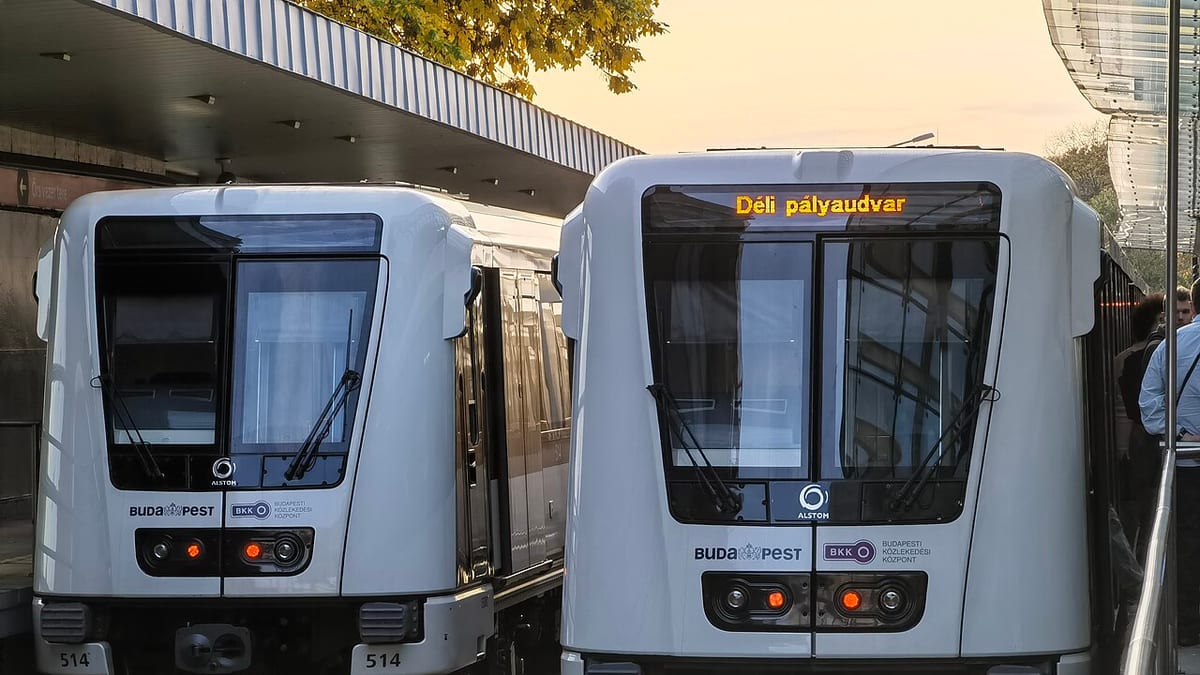
Budapest's metro does not run all night, but older advice that every line finishes around 23:00 is no longer reliable. M2, M3 and M4 have later services, with the last central departures around midnight on Sunday–Thursday nights and around 01:00 on Friday and Saturday nights. Check the station, direction and final connection - not just the line's headline operating hours. [1]
The last train is a departure from a particular station
BKK gives useful reference points for the extended service. At Deák Ferenc tér, the final M2 trains in both directions leave at 00:00 on Sunday–Thursday nights and 01:00 on Friday and Saturday nights. The M3's final departures there differ by direction: northbound and southbound do not share exactly the same minute. [1]
That is why "the metro closes at one" is inadequate travel advice. You may be boarding somewhere farther along the route, changing between lines or needing a connecting bus after reaching the terminus. A station elsewhere on the line can have a different last departure even though it belongs to the same evening's service.
For an ordinary night out, choose a journey one departure earlier than the very last workable connection. This is a planning margin, not an official requirement. It protects against a slow restaurant bill, a walk to the wrong entrance or the need to change platforms without turning the entire evening into a race against a single train.
The extension specifically concerns M2, M3 and M4. Do not automatically transfer their later timetable to M1. A hotel convenient for the historic yellow line during daytime may need a different route after a late performance. Use BKK's dated timetable or BudapestGO to establish the actual journey. [1] [2]
First services: plan the whole early-morning journey
There is no single first-train time that works for every Budapest metro station. A train must leave a terminus before it reaches intermediate stations, and the first useful departure depends on direction. BKK's timetable directory lets you select the line and stop; BudapestGO is more helpful when the journey involves an initial walk and a transfer. [2] [3]
For an early departure, search using arrive by, not simply "leave now." Enter the airport terminal, railway station or other final destination rather than the metro station you think you should use. This can reveal that an overnight bus is more practical than waiting for the first metro.
Check the calendar date carefully for journeys after midnight. A Saturday night out continues into Sunday morning, but it is still one of the Friday/Saturday nights covered by the later pattern. A Sunday evening followed by Monday morning uses the ordinary Sunday–Thursday-night pattern unless a special timetable applies. [1]
Do not construct a tight airport connection by adding one metro journey time to one bus journey time. Include the walk between stops, waiting time and the airport arrival target. A mathematically possible transfer is not necessarily a sensible one when the consequence of missing it is a missed flight.
What replaces the metro overnight
Budapest has an overnight surface network, including round-the-clock tram 6 and airport buses 100E and 200E. Other night buses cover journeys that the closed metro cannot. The important current change is that the night network was reorganised from the night of 1–2 July 2026; old screenshots and pre-change route descriptions may therefore be misleading. [4] [5]
Use the night network as its own system rather than expecting a bus to reproduce every metro trip exactly. The best boarding stop may differ from the entrance you use during the day. Check the stop name, direction and final walking distance in the planner before leaving a venue.
Tram 6 is useful only when its actual corridor fits the journey. It is not a circular sightseeing service that eventually reaches every hotel, nor is it a universal replacement for M1–M4. A direct night bus can be the better answer even when a familiar tram feels easier to recognise. [4]
For visitors staying outside the central districts, pay attention to the final leg. Reaching a large interchange is not the same as reaching the accommodation. Save the hotel address offline and decide in advance whether you will use a planned connection, walk a comfortable route or book a taxi for the remaining distance.
Tickets at night work by validity, not by daylight
BKK says ordinary fares apply on the corresponding regular night services. Tickets can be purchased through BudapestGO or ticket machines, while a single ticket bought on a night bus costs more than one purchased in advance. Do not assume that a closed ticket-office window makes travel free or removes the need to validate. [4]
The basic single-ticket rules also matter when changing modes. A normal single ticket is not an unlimited, all-evening transport pass. Consult the product's conditions for metro transfers and any bus or tram change; a time-based ticket or travelcard may be simpler for a journey involving several vehicles. [6]
Paper tickets and digital products have different validation procedures. Keep the actual travel entitlement available for inspection until the journey has ended, and retain enough battery for a phone-based ticket. A screenshot of a purchase confirmation is not a sensible substitute for understanding how the chosen product must be presented. [6]
When using a travelcard, inspect its expiry time before the night out. A product that was valid during dinner may expire before the return journey. Set its start time around the travel you need rather than activating it automatically at the earliest possible moment.
Airport buses are a separate overnight decision
The 100E Airport Express operates around the clock between the airport and central Budapest. BKK lists overnight intervals averaging thirty to forty minutes, much longer than the busiest daytime pattern. It uses its own airport ticket or an eligible pass-holder add-on, not an ordinary single ticket. [7] [8]
A standard 100E ticket costs 2,500 HUF. The 1,000 HUF add-on is conditional on holding one of the qualifying passes; a visitor's short-duration travelcard should not automatically be treated as eligible. Read the product conditions before buying the cheaper option. [8]
The 200E also operates overnight, but the onward city journey depends on the service available at that hour. Plan the complete connection rather than assuming M3 will still be running when the bus arrives. A lower-priced route is useful only when its additional transfers remain acceptable with your luggage and deadline. [4]
Special events and replacement services can override the pattern
New Year's Eve, engineering work and exceptional events may bring arrangements that differ from the ordinary weekly schedule. BKK Info and the journey planner are the appropriate sources for your actual travel date. A late-service announcement for a past football match does not establish a permanent all-night metro. [2] [9]
For a dependable evening, make two plans: the preferred metro journey and a realistic surface alternative. You then have freedom to stay longer without relying on an imagined train, and you can decide whether the extra wait or transfer is worth it before the metro has already finished.
Sources
- BKK: extended metro hours and last central departures
- BKK: official timetables
- BudapestGO: journey planner
- BKK: night services and fares
- BKK: July 2026 night-network launch
- BKK: ticket and validation guide
- BKK: Airport Express operation
- BKK: airport ticket and add-on eligibility
- BKK: service changes