
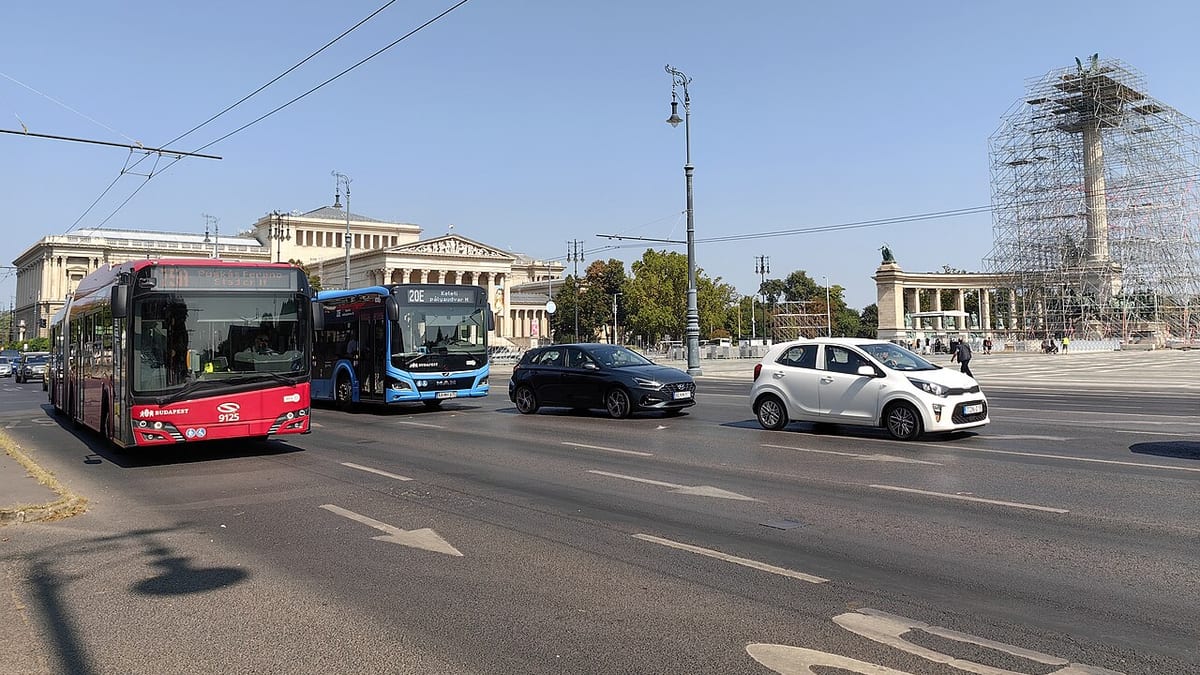
Contactless payment on Budapest buses depends on the service and the machine you use. On 100E, Budapest Pay&GO purchases and validates an electronic airport ticket using the payment card. Since October 28, 2026, bus 200E also accepts card payment for an onboard ticket - but that transaction produces a paper ticket that still needs validation. The two processes are not interchangeable. [1][2]
The crucial distinction: payment can be only the first step
A bank card being accepted does not tell you how the resulting ticket works. On one service, the payment creates a validated electronic entitlement; on another, it buys a paper ticket that must be stamped. Treat the ticket instructions as part of the transaction, not an optional detail afterward.
BKK's October 2026 notice explains the new 200E card-payment arrangement and connects it with earlier card-purchase availability on routes 105, 210 and 210B. This is a rollout on specified services, not proof that every Budapest bus has identical bank-card ticketing. [2]
For an unfamiliar route, choose a ticket in advance or use the official app when that is suitable. Do not board assuming that any visible card reader performs the same function as the one you used on the airport express.
After paying, check what you received. A printed ticket, an app ticket and a Pay&GO transaction each have their own validation and inspection process. The safest habit is to complete that process immediately rather than waiting until an inspector appears.
100E: Pay&GO creates the airport ticket
Budapest Pay&GO operates on 100E and at the metro under BKK's published coverage. On 100E, the system permits the purchase of airport tickets for up to five people in the same transaction process. No paper ticket is issued; the payment credential is used for checking the entitlement. [1]
Use the same card or device during inspection that you used to pay. A physical card and the version of that card stored in a phone wallet can be represented differently in payment systems, so switching between them can complicate verification.
The published 100E airport shuttle ticket is HUF 2,500. Do not replace it with an ordinary city single ticket merely because the vehicle is operated within the public-transport system. The airport express has its own fare product. [3][7]
For a group, select the correct number of tickets and keep the payment device with the travelers whose fares it covers. One tap should not be assumed to cover an unspecified number of companions.
200E: card purchase still leaves a paper-ticket task
On 200E, the new onboard card-payment option buys the onboard single ticket from the driver's sales arrangement. BKK explicitly distinguishes that purchase from validation: the paper ticket must still be validated in the vehicle. [2][4]
The listed onboard single ticket costs HUF 700, compared with HUF 500 for a standard single ticket bought in advance through an appropriate channel. Paying by card on the bus is convenient, but it does not automatically make the onboard product the cheapest choice. [3]
Collect the ticket, check that the transaction succeeded and validate it promptly. A card notification is not a substitute for the required paper ticket, and an unstamped ticket is not the same as a valid journey merely because money has left the account.
This is the most important difference for arriving passengers who have read that both 100E and 200E now accept contactless payment. The payment method may look similar, but the ticketing consequence is different.
Transfers change the fare comparison
A standard single ticket generally covers one uninterrupted trip under its conditions, with a specified exception for transfers within the metro system. Changing from 200E to the metro normally requires another ticket or a time-based product that covers the transfer. [4]
At the published rates, one advance single for the bus and another for the metro total HUF 1,000. An onboard HUF 700 bus ticket plus an advance HUF 500 metro ticket total HUF 1,200. These are calculated examples, not a universal airport fare for every route.
The ninety-minute ticket is listed at HUF 850 and permits qualifying transfers within its conditions. BKK explains that the final transfer must begin within the validity window, after which the final journey may continue as allowed by the product. That is different from assuming the traveler must leave the last vehicle exactly when ninety minutes elapse. [3][5]
For a visitor making several city trips, a twenty-four-hour ticket at HUF 2,750 or a seventy-two-hour ticket at HUF 5,750 may be relevant. Compare your actual journeys and the exclusions, including the special 100E fare, rather than assuming a city pass covers every airport service. [3][7]
App tickets have their own validation process
BudapestGO and other supported mobile-ticket applications are not simply digital wallets holding an already valid journey for every circumstance. Follow the required activation or validation instructions for the selected product and service. [8]
BKK's October 29, 2026 announcement describes a rollout of interior QR codes on surface vehicles to make validation easier. A rollout does not mean every vehicle has already received the new arrangement, and the existence of an interior code does not remove the obligation to validate promptly. [6]
The operator also explains that codes can be disabled during inspection. Do not wait until an inspection begins to turn a purchased but unvalidated mobile product into a ticket. The correct sequence is to validate when required at the start of travel.
Test the app and payment method while you have time and a stable connection. A phone that cannot display the required ticket during inspection creates a practical problem even when the traveler believes a purchase was completed earlier.
Pay&GO is not a promise of automatic daily capping
The published Pay&GO system sells the relevant ticket for the covered service. Do not assume that repeated bank-card taps will automatically become the cheapest possible day pass or that a bus transaction can be combined with every other purchase across the network. [1]
Choose a pass deliberately when it suits your itinerary. For a traveler staying centrally and walking most of the time, occasional tickets may be sufficient. For someone using transport repeatedly, a time-based pass can simplify both costs and decisions.
Keep payment methods consistent during inspection and retain any paper tickets until the journey is complete. For a failed transaction, resolve the ticket purchase rather than treating an attempted tap as an entitlement to ride.
A reliable airport arrival
Choose the route first: 100E for its particular express journey and fare, or 200E with the appropriate onward connection and ticket coverage. Then decide whether to use Pay&GO, an advance ticket, an onboard paper purchase or a mobile product.
On 100E, follow the electronic Pay&GO instructions and retain the same payment credential. On 200E, remember that the new card purchase still produces a paper ticket to validate. That single distinction prevents the most consequential misunderstanding in Budapest's current contactless bus arrangements.