
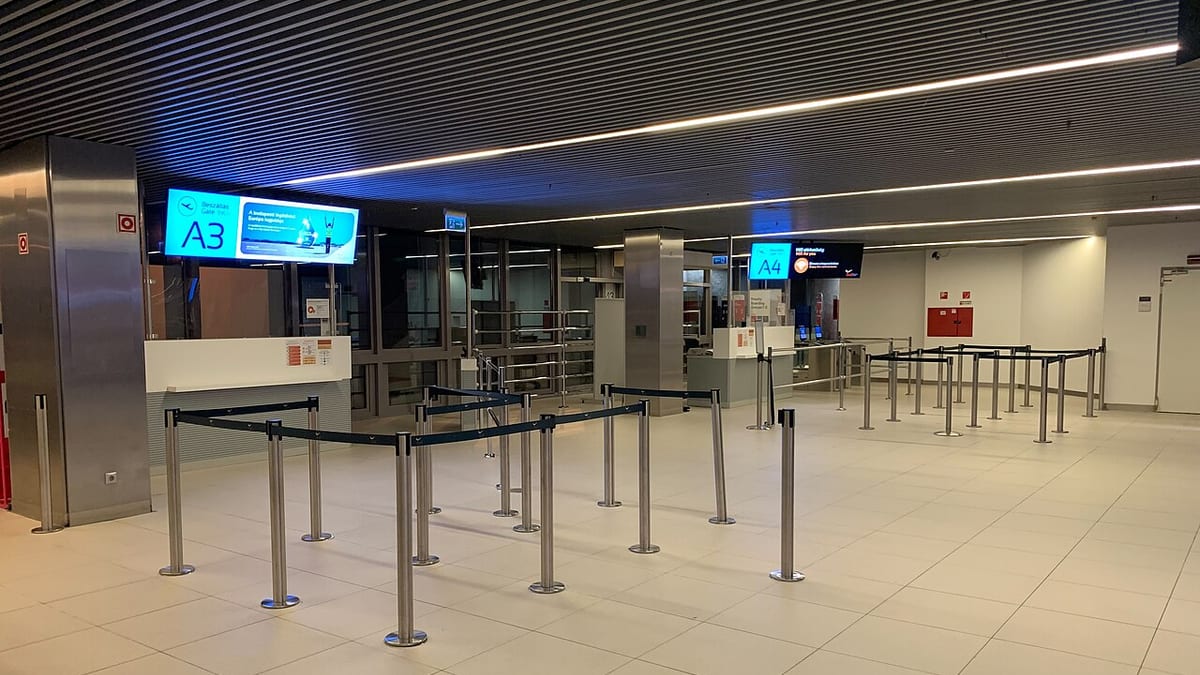
Aim to reach Budapest Airport at least two and a half hours before departure, following the airport's current passenger advice. Add more margin when your airline, documents, baggage or assistance arrangements require it. Work backward from the flight and airline deadlines - not from the time a check-in desk opens or an unusually short security wait displayed online. [1]
Start with the airport's advice, then apply your airline's rules
Budapest Airport's summer 2026 guidance recommends arriving at least two and a half hours before departure. That is a useful baseline for ordinary planning, not a promise that every traveler will finish all procedures within a particular time. [1]
The airline still sets the deadlines that determine whether you can check in, surrender baggage and board. These can differ materially. Eurowings' Budapest information, for example, lists check-in opening two hours before departure and closing sixty minutes before departure. The opening time does not mean that arriving at the airport at that moment is the best plan for everyone. [2]
For a complicated departure, I would plan around three hours rather than trying to use every last minute in the city. Examples include unfamiliar travel documents, several bags, young children, reduced-mobility assistance or a non-Schengen flight requiring additional formalities. This is a conservative planning recommendation, not an official minimum for every flight.
Do not calculate your buffer from the scheduled departure alone and then ignore boarding. The aircraft's departure time is not the deadline for reaching the gate. Save the airline's actual check-in and boarding instructions where you can find them without searching through promotional emails.
Keep four different deadlines separate
The journey has several stages: reaching the terminal, completing check-in or bag drop, passing the applicable controls and reaching the correct gate before boarding closes. Finishing one stage does not remove the next.
Online check-in can let eligible passengers with an accepted boarding pass proceed toward security without a normal check-in-desk stop. It does not remove baggage drop when you have checked luggage, or any document verification your airline requires. Budapest Airport directs passengers to the airline-specific check-in information and terminal displays. [3]
A useful approach is to write down the earliest hard deadline first. A passenger whose bag drop closes sixty minutes before departure should not use another airline's forty-minute deadline as reassurance. Likewise, having only hand luggage is not permission to arrive after the airline requires document checks.
Allow for the walk after security. Boarding areas and passport-control requirements depend on the flight. Avoid scheduling a meal or lounge visit before you have identified the gate and established when you need to be there. Relaxing after the essential steps is different from assuming the airport is already finished because you passed security.
Security wait displays need interpretation
The airport advises passengers to compare the security waiting times for the two terminal areas where appropriate. However, its security page also explains that checkpoint opening is coordinated with check-in operations. A displayed wait of zero to five minutes can indicate that a checkpoint is closed, not that you have found an empty shortcut. [1] [4]
This is particularly important for very early departures or an overnight stay at the airport. Arriving extremely early may give you more time landside without giving you access to the departures area. It should not be treated as a guarantee that security, shops and lounges are already available.
Current published liquid rules require containers of no more than 100 millilitres inside the permitted one-litre transparent resealable bag, subject to the stated exceptions. Prepare this before joining the queue. Follow staff instructions about what to remove or leave in your bag rather than applying another airport's scanner rules automatically. [4]
The efficient choice is preparation, not gambling on a short queue. Keep the boarding pass and required documents accessible, pack items in a way that makes inspection manageable, and avoid last-minute repacking that consumes the buffer you intended to keep.
Non-Schengen flights need another stage
Budapest Airport's departure guidance places passport control for non-Schengen flights after security, in the Terminal 2B departure process. Passing the security checkpoint therefore does not mean all border formalities are complete. [1] [5]
Do not use "international" and "non-Schengen" as interchangeable terms when planning. Identify the actual destination and itinerary, then follow the airport and airline instructions that apply to your documents. A traveler requiring additional verification should preserve more time than someone who only needs an uncomplicated journey to the gate.
This guide does not estimate an average immigration queue. Such a number would be a weak basis for a particular flight without measured, applicable evidence. The practical decision is to retain time for the necessary process rather than assuming it will be instantaneous because the security display looks favorable.
Connecting passengers should also distinguish a protected connection from separate tickets. An itinerary sold with separate baggage collection and recheck needs a different calculation from remaining within the transfer system. Ask the operating airlines about the exact arrangement instead of applying a city-departure buffer to every connection.
Downtown bag drop is useful only when you qualify
Budapest Airport's AirportHUB information describes a downtown baggage service for eligible Wizz Air flights departing between noon and midnight. The published conditions require handing over bags at least four hours before departure, with exclusions including Baku and Tel Aviv. The listed charge is HUF 3,500. [6]
That is a specific service, not a general right to leave any airline's luggage in the city. Read its current conditions, including boarding-pass requirements, before designing the departure day around it. A desk that can print boarding passes does not necessarily accept checked bags for the same range of airlines.
Eligible travelers may value the ability to spend the remaining city time without luggage. But the service does not remove the journey to the airport, security, passport control when applicable or the gate deadline. Do not convert a luggage convenience into an aggressive late-arrival plan.
Build the city transfer into a separate calculation
BKK's 100E Airport Express runs around the clock between the central city and the airport. The operator publishes service information and an indicative journey time, but road conditions and the journey to the boarding stop still matter. [7]
For an illustrative 15:00 flight, a two-and-a-half-hour airport target means being at the terminal by 12:30. Your hotel departure must be earlier by the entire transfer: walking to the stop, waiting, riding and reaching the right airport area. This arithmetic is a planning example, not a forecast of traffic on your date.
Choose the connection that preserves the airport target even after a modest delay. When a taxi or private transfer is more practical for your group, agree the pickup location and allow the same distinction between leaving the hotel and reaching the terminal.
The safest useful rule is straightforward: follow the airline's specific requirements, use the airport's two-and-a-half-hour advice as a baseline, and make transport and preparation support that target. A departure day should not depend on every stage being faster than expected.