Budapest's Great Market Hall is worth visiting for its architecture and a selective look at food shopping, especially when it fits a walk around Fővám tér. Go without assuming that every stall is local, every meal is inexpensive or every published timetable agrees. The operator's Hungarian pages currently list Sunday opening, unlike its older English general-hours page. [1] [2]
Treat it as both a market and a visitor attraction
The market is free to enter, so you can appreciate the space without committing to a meal, souvenir purchase or guided tour. The operator identifies the building at Vámház körút 1–3 and provides a directory of traders and market services. [1]
This makes a short exploratory visit a sensible choice. Walk through once before buying, note which counters interest you and decide whether the food on offer matches what you actually want to eat or take home. There is no need to turn the visit into a compulsory shopping exercise.
The hall also attracts visitors looking for recognizable Hungarian products and gifts. The operator's Hungarikum presentation is part of that offer, but the presence of a souvenir section should not be mistaken for a guarantee that every object is locally made. Read the label and ask about the producer when origin matters. [3]
Travelers who enjoy observing ordinary food shopping may prefer to concentrate on the food counters. Someone interested mainly in architecture can make a shorter visit. Neither needs to apologize for skipping the parts that do not appeal.
Look up before looking at the price tags
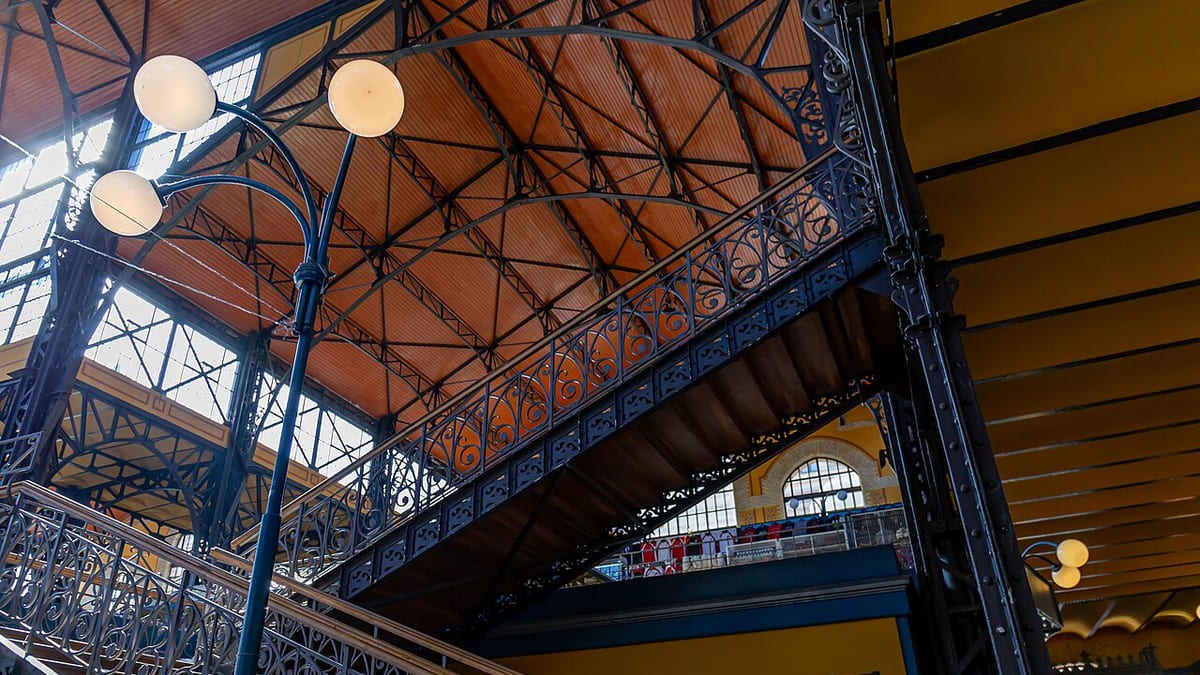
The operator's history identifies Samu Pecz as the architect and dates the opening ceremony to 15 February 1897. The building formed part of a broader move toward organized market halls in a rapidly developing city. Its structure and decorative elements are therefore as relevant as the goods sold inside. [4]
The same history discusses the iron construction and Zsolnay ceramic elements. Rather than treating those as facts to tick off, look at how the large open space, repeated structural forms and upper levels make the building usable. The visual effect comes from an infrastructure project that also wanted to be an important public building. [4]
An upper-level view can help you understand the scale, where available and suitable for your mobility. Do not assume that a photograph taken from a gallery establishes a step-free route to that viewpoint. Ask staff about the practical route when stairs are a concern.
The hall's appeal is not dependent on finding a perfect meal. Architecture enthusiasts can get value from a careful circuit and a few details, then eat somewhere that better suits their preferences. Free entry makes that a perfectly reasonable way to visit.
Resolve the opening-hours discrepancy before a Sunday trip
The operator's Hungarian market page and Hungarian opening-hours directory currently publish Monday–Friday 06:00–18:00, Saturday 06:00–16:00 and Sunday 10:00–16:00. Its English market-specific page repeats that pattern. Public-holiday closures are stated separately. [1] [5] [6]
However, the operator's English general opening-hours page still gives the older pattern with Sunday closed and shorter Monday and Saturday hours. That is a material contradiction within the same organization's website, not a reason to silently choose whichever timetable best fits an itinerary. [2]
For planning, the matching Hungarian pages and market-specific English page provide the stronger basis for the current schedule. When a Sunday visit is essential, confirm with the market rather than relying on an older guide that automatically rules Sunday out - or assuming every trader follows the building's full opening span.
Even on an ordinary weekday, building access is not a promise that all stalls are serving everything from the first minute to the last. Choose the timing around your purpose. A food-shopping visit and a late lunch have different requirements, and a hall that is technically open may not offer the same choice throughout the day.
Buy food by the unit that is actually being sold
Before ordering, establish whether the displayed price is per portion, per item, per kilogram or per smaller weight. A low-looking number can be entirely legitimate while describing much less food than you imagined. Asking the unit is more useful than judging value from the size of the sign.
For a prepared meal, ask what is included and what costs extra. Toppings, accompaniments and drinks can change the total. This is ordinary purchase advice, not a claim that every vendor adds unexpected charges or that the market is uniquely risky.
Decide the portion before the seller prepares it when that is possible. For a snack, a simple order may suit you better than a large combination chosen because it appears in someone else's photograph. For a full lunch, compare the complete meal with nearby alternatives rather than assuming market food must be the cheapest option.
Ask about allergens and ingredients directly when relevant. A dish name or an attractive display is not enough to establish suitability for a serious dietary requirement. Choose another option when the vendor cannot provide the information you need.
Choose souvenirs that survive the journey
For packaged food, inspect the producer, ingredients, net quantity, storage requirements and best-before information. A decorative package may be part of the appeal, but it should not hide the details needed to compare two products.
Think about where the item will be kept between purchase and departure. Something requiring refrigeration is a different proposition from a sealed dry product. Buying earlier in the day is not helpful when it leaves a temperature-sensitive item in a warm bag during several hours of sightseeing.
For travel across a border, consult the destination's customs and food-import rules before buying meat, dairy or other restricted categories. Permission to buy an item in Hungary does not establish permission to bring it into another country. The relevant rule depends on the destination and product; there is no universal market-souvenir exemption.
For non-food gifts, ask about materials and origin and compare more than one stall when the purchase is substantial. A pleasant memento does not need to be expensive, and a product being sold in a historic market does not by itself prove its manufacturing history.
Keep the visit geographically simple
The operator lists access by M4 and several tram routes, including 47 and 49. Use the exact market address and current journey planning for your starting point rather than driving to an uncertain parking space simply because the map shows roads nearby. [1]
The hall fits naturally into a Fővám tér and riverside outing. Choose one nearby continuation, then leave enough time for the market itself instead of treating it as a hurried stop between unrelated appointments. A traveler with luggage may prefer to store it first; shopping and browsing are easier without managing a suitcase in every aisle.
I would prioritize the hall for visitors interested in food, architecture or browsing without a fixed purchase. I would not make it the centerpiece of an entire day for someone seeking a quiet, intimate farmers' market or a guaranteed bargain meal.
Go with a specific but flexible purpose: inspect the building, buy one product thoughtfully or choose a meal after comparing the actual offer. That approach captures what the Great Market Hall does well without demanding that it represent every kind of Budapest food experience at once.
Sources
- Budapest Market Halls: Hungarian Great Market Hall page
- Budapest Market Halls: conflicting English general-hours page
- Budapest Market Halls: Hungarikum presentation
- Budapest Market Halls: history of the building
- Budapest Market Halls: Hungarian opening-hours directory
- Budapest Market Halls: English market-specific page