
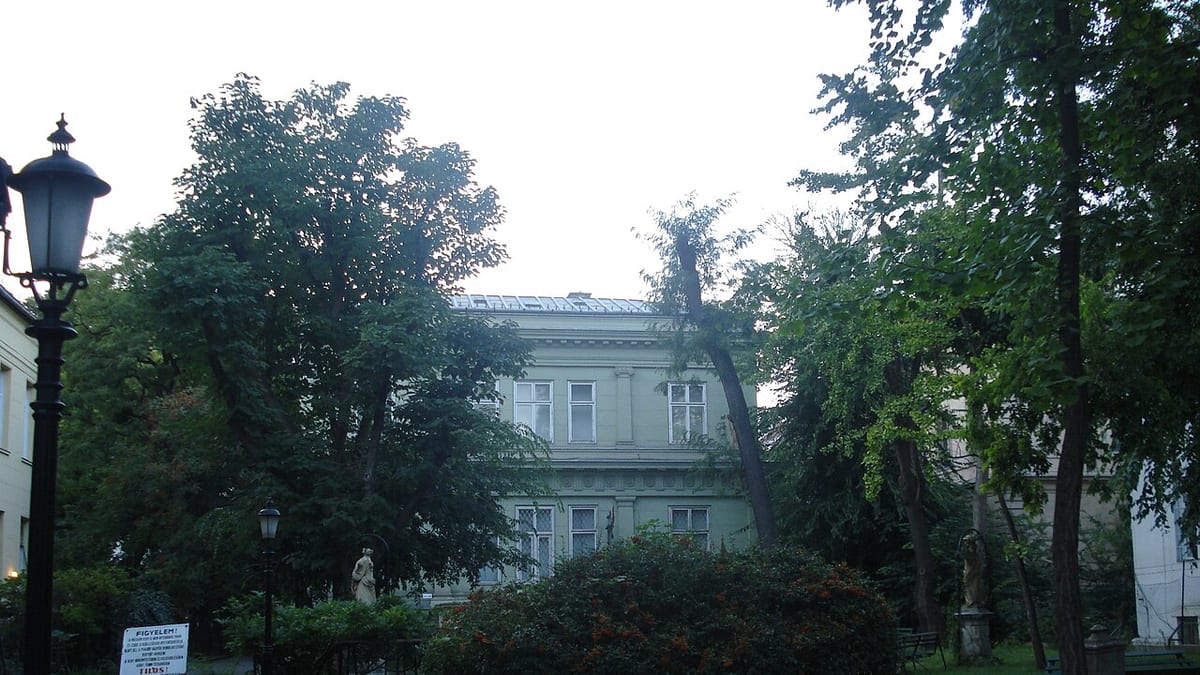
Ráth György Villa is worth visiting for decorative arts, interior design and a smaller museum experience focused on Art Nouveau. Choose it because objects and furnished settings interest you, rather than as a substitute for a vast painting collection. The villa is a separate Museum of Applied Arts venue at Városligeti fasor 12, not the institution's main building on Üllői út. [1] [2]
A collection displayed in a house, not an untouched household
The villa presents important pieces from the Museum of Applied Arts' Art Nouveau collection. Its domestic scale offers a useful way to consider furniture, ceramics, glass and decoration together rather than treating each category as a completely separate subject. [1]
There is an important interpretive distinction. The museum's family guide explains that the picture gallery and upstairs dining room broadly evoke the arrangement from György Ráth's lifetime, while other rooms present the modern Art Nouveau spirit of his period. It is therefore misleading to describe every object and room as the family's untouched original home. [3]
That distinction makes the visit more interesting, not less authentic. You can compare the collector's domestic setting with the museum's choices about how to explain a style. Ask what belongs to the history of the house and what has been brought together to illuminate a wider artistic movement.
It also helps set expectations for scale. This is a focused decorative-arts visit, not a survey of every era in Hungarian art. Travelers who prefer a narrower subject explored closely may enjoy it more than those whose main interest is moving through a large sequence of famous paintings.
Look at relationships between objects
Rather than trying to memorize every maker, choose a few objects and study how they work. With a chair, examine the relationship between structure, ornament and the position of the person using it. With a vessel, consider whether the surface decoration reinforces the shape or seems to transform it.
The museum's published exhibition inventory includes work associated with Pál Horti and Zsolnay, among many other makers. It records materials and techniques as well as names, offering a way to understand why a piece is more than a decorative photograph. The inventory is a reference to the collection, not a guarantee that each listed object remains in the same position today. [4]
Read the labels for distinctions between designer and manufacturer. A design can travel between workshops, materials and cities; the person who conceived an object and the organization that produced it are not always the same. This is particularly useful when comparing handmade details with pieces developed through more organized production.
Take one room as an ensemble before inspecting individual objects. Which colors or forms repeat? Does the furniture make the room feel unified, or do different pieces compete for attention? These questions provide a rewarding route through the display without requiring prior specialist knowledge.
The house makes a good visit for the right kind of family
The museum publishes a family activity booklet aimed at ages 10–14. Its existence suggests a more useful approach than expecting children simply to admire furniture quietly: give them a visual task, a comparison or a design question. The published booklet is in Hungarian, so language support may be needed. [3]
For example, ask each person to choose an object they would place in a room today and explain why. The task turns looking into a decision, without requiring anyone to touch the exhibits or complete every label. An adult can use the same approach to slow down a hurried visit.
Very young children introduce more practical constraints. The museum's published rules do not allow strollers in the exhibitions and require children under fourteen to be accompanied. They also specify how very young children may be carried. Read those conditions before deciding whether the setting fits your family's needs. [5]
A smaller museum is not automatically easier with every child. It may offer a more manageable scope, but the objects still require careful behavior and distance. Plan a shorter, purposeful visit when attention is limited rather than assuming a long stay is necessary to make the admission worthwhile.
Check access before building the day around it
The museum's published visitor policy describes the listed villa as not wheelchair accessible. That is a consequential limitation, not something to discover after arriving at the door. Anyone needing step-free access should contact the institution about their exact requirements and any current arrangements before purchasing. [5]
The same policy gives standard opening as Tuesday–Sunday, 10:00–18:00, with Monday closed, and directs visitors to the museum for exceptions. It asks visitors to leave exhibition rooms before the building's final closing time. Do not plan a substantial visit by arriving only a few minutes before six. [5]
Current ticket categories and prices should come from the museum's linked ticketing service. This guide does not quote a fee that could not be confirmed from an accessible current price page. Compare the admission for your group and any temporary exhibition or guided activity separately. [6]
The practical question is not merely whether the museum is open, but whether the portion you want is accessible under the conditions you need. A building can be operating normally and still be unsuitable for a particular mobility requirement or family arrangement.
Temporary exhibitions are a separate reason to visit
The museum-sector publication Magyar Múzeumok reports Patterns That Live On, a collaboration between the Museum of Applied Arts and the Moholy-Nagy University of Art and Design, for 20 October 2026–3 January 2027. Its subject is the relationship between teachers, pupils and the transmission of creative knowledge. [7]
That is a different reason to visit from the permanent Art Nouveau collection. A traveler interested in contemporary design may find the relationship between the two especially appealing, while someone primarily seeking the historic interiors should still plan around the permanent display.
Keep the dates attached to the recommendation. A temporary exhibition extending into January is not a permanent feature, and its appearance in search results after closing would not establish continued availability. Confirm the actual exhibition and ticket arrangement for your intended visit.
Fit it into the day without turning it into a detour
Use the full address, Városligeti fasor 12, in your journey planner. The Museum of Applied Arts lists several venues, and navigating only to the institution's name can send you to the wrong building. [2]
I would reserve a flexible museum block rather than combine the villa with several other timed entries. Start with the permanent collection, then decide whether the temporary exhibition warrants more time. Leave a break afterward to think about what you saw rather than immediately demanding attention for another dense collection.
The villa is a particularly good choice for repeat visitors, design enthusiasts and travelers who prefer a focused indoor experience. It is less essential for someone with one short day and no particular interest in decorative arts.
Its value lies in making objects and rooms worth looking at closely. Go with a few questions, respect the access constraints and let the smaller scale work in your favor. You do not need to see the largest museum in the city to have one of the most attentive visits of your trip.
Sources
- Museum of Applied Arts: Ráth Villa introduction
- Museum of Applied Arts: venues and addresses
- Museum of Applied Arts: family guide to the villa
- Museum of Applied Arts: published exhibition-object inventory
- Museum of Applied Arts: villa visitor policy
- Museum-linked ticketing service: Ráth Villa
- Magyar Múzeumok: Patterns That Live On exhibition